As we have noted more than once, there are oddities about how obesity has been regarded in different places and at various points in history. In some parts of the world, civilization has entered a phase where, rather than causing people to be emaciated, a shortage of money could (against all logic) make them fat. Today, low-income people are sold a plethora of products filled with more fattening ingredients than nutritious ones.
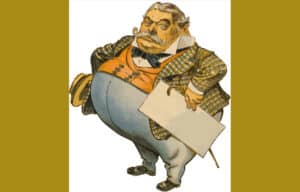
In the Middle Ages, to be fat and to have fat wives and heirs was way cool, a power move, a proud public assertion of worthiness, and a self-declaration of importance that was widely accepted as such, regardless of the thoughts of any lower members of society.
In the present day, a big waistline might mean either wealth or poverty. In circumstances where the wealthy are viewed as greedy parasites, to call such a person fat is an insult. At the same time, in any societal environment where the poor are viewed as undeserving sub-humans who eat up all the taxes that are unfairly extracted from the wealthy, to be called fat is an equally potent insult when hurled at them.
The vagaries of earthly life
Some people enter the world with blue eyes. Others are born deaf. Some emerge from the womb left-handed. And some arrive with a genetic predisposition to obesity — or are thrust into circumstances which (for them, anyway) will make it inescapable.
Skip ahead four decades. In which of those situations, after 40 years of existence, is a human most apt to be mocked, ridiculed, disrespected, scorned, rejected, vilified, blamed, or shamed? Which of those conditions is most likely to cause a grown adult — who may be successful, and even fulfilled, in one or more aspects of normal life — to seek help from a mental health professional? Obesity, of course.
Plus, the lack of choice
Another factor here is that while a person may quite readily have the freedom to choose between being left-handed and wealthy, or left-handed and impoverished, other situations are not so amenable, and obesity is one of them. In the past few years, advances have been made in this area of knowledge, to the point where more people realize that obesity can definitely influence a person’s prospects, and even lead them into a life of relative financial deprivation.
A typical citation comes from the journal BMJ Open:
Studies suggest that the obese are more likely to be perceived as lazy, unsuccessful, weak-willed and undisciplined. On basis of these negative stereotypes, the obese face various weight penalties in the labour market, which include higher job insecurity, lower chances for a job and general discrimination.
Along with many other sources, that one has noted the mutual disadvantages of being both fat and broke:
[L]ower income is associated with higher levels of psychosocial stressors which include decreased control over life, and higher insecurity, social isolation, stress and mental disorders.
[T]he stigmatization of the obese also correlates with material (ie, less income through weight penalty), behavioral (ie, change in health-promoting behavior through discrimination), as well as psychosocial factors (ie, self-stigma may inflict lower control over life, social isolation, stress, lower self-esteem) that may, again, lead to a higher risk of obesity.
One reason why such individuals seek counseling is to escape the curse of self-stigmatization, which all too readily transmogrifies into psychological malfunction. It’s bad enough to have other people metaphorically beating you up, but when you start doing it yourself, the situation really calls for intervention.
(To be continued…)
Your responses and feedback are welcome!
Source: “Income and obesity: what is the direction of the relationship?,” BMJ.com, January 2018
Image by Kaz_Graphics/Pixabay
 FAQs and Media Requests: