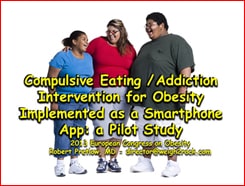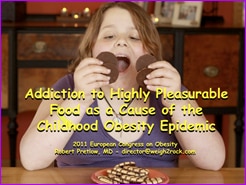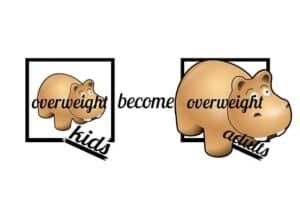
While obesity is not exactly a curse, at least not compared to some other fates, like life inside an iron lung, it is still not a future anyone looks forward to — especially a parent in regard to a child. The purpose here is not to condemn bariatric surgery, GLP-1 meds, or any other weight loss trend, but to emphasize that, in every instance, the mind and heart need care too. Any sort of extreme change can mess up a person’s life, and in the case of massive weight loss, mental and emotional health must be considered and provided for.
Better yet, and most of all, an important goal is to convince parents to begin early with ensuring that such drastic measures are never needed. Chronic obesity is the sort of problem much better avoided in the first place than faced later under difficult circumstances.
To put it as plainly as possible, one of our goals is to encourage parents to steer clear of, rather than ever need to handle, such problems. We point out the many disadvantages of being an overweight adult in the modern world, for a reason: in hopes that parents will understand that preventing obesity now is infinitely more valuable than dealing with it later.
Good news and bad news
The science of prosthetics has come a long way, especially thanks to experiences gained in treating patients wounded in needless wars and preventable vehicle accidents, etc. A person can get an artificial leg so well-crafted that an onlooker might not be able to spot it. But no parent who learns about the existence of such marvelous devices would proceed from there to conclude, “Well, if my kid needs an amputation, it won’t be such a bad thing.”
Although that sentiment may be true, it has no place in our minds as long as the best alternative still exists: to do everything humanly possible to make sure that our child never needs a leg replaced. Likewise, as parents and other relatives; as teachers; as medical personnel of every sort: Our energy is better spent in guaranteeing that our children, the ones under our care, for whom we are responsible, don’t get fat!
Roughly one-half to two-thirds of children obese at age seven may still have obesity at 18, and roughly two-thirds may still have it at 25. The available evidence does not support a precise figure at 65 or at death, but the estimated numbers are large. These are population averages, not a child’s destiny.
Early, family-based treatment can change the trajectory, and improvement does not require reaching a “normal” BMI immediately. Health can be substantially improved by preventing further excess weight gain as height increases. Meanwhile, let’s not delude ourselves. To think, “In a couple of years he’ll get interested in sports and the problem will solve itself” is false comfort. This is not a chance worth taking.
Back to Goffman’s findings
Erving Goffman’s book, Stigma: Notes on the Management of Spoiled Identity,
[…] is specifically concerned with the issue of “mixed contacts” — the moments when stigmatized and normal are in the same “social situation,” that is, in one another’s immediate physical presence…
To the person who is unconcealably different, this becomes a problem when she or he perceives — rightly or wrongly — that others certainly do notice the difference and, no matter what they may claim or pretend, do not really accept it. The subconscious mind concludes some version of “I’m not what I should be; I don’t belong in company with this person or these people; they don’t and never will accept me as worthy or equal…”
And on and on into an infinite number of sad and dire possibilities. This is the fertile mental/emotional soil from which shame grows and then transmogrifies into any number of emotions and convictions ranging from simple unworthiness to suicidal intention.
Goffman quotes examples drawn from a large number of sources, like Katharine Butler Hathaway’s memoir detailing the effects of spinal tuberculosis on her childhood years and later life:
I didn’t scream with rage when I saw myself. I just felt numb… I saw a stranger, a little, pitiable, hideous figure, and a face that became, as I stared at it, painful and blushing with shame.
That person in the mirror couldn’t be me. It became impossible that I should speak of it to anyone, and the confusion and the panic of my discovery were locked inside me then and there, to be faced alone, for a very long time to come…
Not surprisingly, Hathaway specifically noted the emotion of shame, along with being “horror-struck” when she did not recognize herself in the reflecting glass. Perhaps even worse, that feeling did not remain in place but…
Slowly and stubbornly my robust persistent illusion of well-being and of personal beauty spread all through me again, and I forgot the irrelevant reality and was all unprepared and vulnerable again… My disguise had been put on me without my consent or knowledge, but it was on me for life.
Quite clearly, the trauma of being unacceptably different does not strike just once but can recur at any time, amongst any surroundings, over and over, many times a day, ad infinitum.
Your responses and feedback are welcome!
Source: “Stigma: Notes on the Management of Spoiled Identity,” WordPress.com, 1963
Source: “The Little Locksmith,” K. B. Hathaway, Coward-McCann, 1943
Image by geralt/Pixabay
 FAQs and Media Requests: