Seen on a neighbor’s wall, a poster stating, “What happens at Grandma’s house never happened.” Numerous possibilities present themselves. And if one word was changed — for instance, “What happened at Grandpa’s house never happened” — the imagination could go dark, but that is not our topic. The problem here, though not subject to legal prosecution, is nevertheless responsible for plenty of damage.
In the sort of ongoing warfare that can all too often occur in the home, a favored tactic is abuse based on personal characteristics, of which obesity is a temptingly obvious weapon — and a versatile one. If the parent is lucky enough to be of normal weight, a child can be emotionally abused for being obese.
Conversely, if the parent is obese, resentment can be directed toward a child who seems to have escaped that fate. The versatility is extended by the possibility of any generation pointing the weapon at either the elders or the youngsters.
In assessing whether a child might need some sort of therapy, it behooves a parent to consider whether he/she himself/herself might also benefit from therapy. After all, how did the kid get so messed up in the first place? Common sense says to look at the mother and/or the father, and if you happen to be either of those, go ahead and draw the obvious conclusion. It’s just possible that you could benefit from some inner work, too.
Relentless persistence
Otherwise, without psychological and emotional help, when the same resentful people become grandparents, the sick drama persists through another generation, to potentially be handed on to yet another generation after that, and so on, ad infinitum.
One thing we are talking about here is the everlasting variety of stuff that grandparents have been known to do, out of some obscure sense of ancient leftover spite that was churned up during the daughter’s or the son’s childhood, with residual bad feeling that winds up being inflicted on an innocent child.
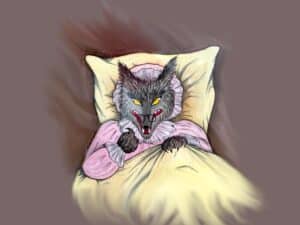
Regarding the illustration at the top of the page, please refer to the traditional tale, “Little Red Riding Hood,” in which an alleged grandma is actually a vicious predator in disguise. Nobody wants that, yet some of us have experienced the phenomenon firsthand, as either victim, perpetrator, or both. Yes, this is the sort of dynamic that tends to repeat itself in families, tainting the emotional lives of one generation after another.
Alluring possibilities
Folks really need to look at the family dynamics that they have managed to ignore or tolerate. But when it comes to the kids, look out. On hearing the happy news that a daughter or daughter-in-law is expecting, something regrettable can happen in the brains of even the nicest women.
All bets are off, and specialized weapons have been lying in metaphorical closets for years, gathering dust, but ready to be spiffed up and called into use — start the countdown — four months from now… two months from now… The kid pops out, and soon, the mom and the grandma will need to navigate a whole new dynamic between them, and no matter what the relationship has previously been, there will be some surprises.
Neither party might even be conscious of the sense that there are scores to be settled. But that’s the tricky thing about feelings. They rarely rise to the level of consciousness. In the most outwardly cordial relationship between relatives, just below the surface might be an emotional jungle full of ravening beasts.
Beware of the urge to settle old scores
Buying too many gifts, exposing kids to radical ideas or alternate religious viewpoints, letting them stay up too late, allowing them to view inappropriate or undesirable TV programming, feeding them bowls of icing, taking them to unhealthy environments… There are a thousand ways to punish daughters and sons for past offenses by trifling with the rules and standards those offspring have drawn up for their own children. For a member of the older generation to declare, “That kid needs boundaries,” or to go in the opposite direction, “She’s not fat, just cuddly,” are both bad if motivated by ancient scripts that have been lurking around, just waiting for a chance to jump into the picture.
There are many ways to allegedly spoil a child — some of them more damaging than others. What is being suggested here is for each adult, whether parent, grandparent, step-parent, or babysitter, to carefully examine their own motives and self-deceptions about what the heck is actually going on.
“What do you call yourself doing?” is a countrified way to say, “What do you think you’re doing?” and in either form, or expressed in any other way, it is a valid question that people really do not ask themselves often enough.
Your responses and feedback are welcome!
Image by Grafixxkoeln/Pexels
 FAQs and Media Requests: