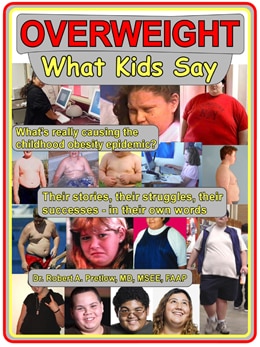
The previous post touched on a couple of aspects of obesity, whether found in a child or an adult. The minute this subject comes up, it obviously raises some questions, such as: Why do many allegedly civilized adults feel it is their responsibility to notify overweight people about how much they disapprove? Granted, this treatment, when meted out to adults, and by adults, is much more subtle than the techniques employed by mean children. But it’s there, nonetheless.
Dr. Pretlow once pointed out that, according to research done by UC San Diego and apparently bumped offline since then, a group of young people undergoing chemotherapy against cancer, and another group of young people who were obese, rated their quality of life as pretty much the same.
A certain degree of puzzlement elicited a follow-up question: “If obese young people are truly miserable, due to being obese, why don’t they simply eat healthy, exercise, lose weight, and not be miserable anymore? Obviously, something else is going on.” That mysterious factor may simply (but, aha, not really so simply) be that they can’t stop using food as a tool in a transparently illogical coping mechanism. Deciding to eat less is quite a different matter from, for instance, deciding not to have cancer.
Hmmm…
Looking at this objectively, it seems possible that people, including the young, may have adopted for their own comfort the idea that all obesity is the fault of food manufacturers who fill their products with fattening ingredients, transforming them into “problem foods.” Which of course is valid to a certain extent — but nowhere near an extent that would justify all the overweight people using it as an excuse, all the time.
To make a long story short, it seems pretty obvious that, as Dr. Pretlow noted,
[…] rather than incriminating specific constituents of food as the cause of obesity, we should look at why people consume large amounts in the first place, and keep doing so, even though they are aware that it will result in further weight gain.
At any rate, either way, it is glaringly obvious that many overweight and obese people of all ages have a pretty hard time of it, just maintaining enough morale to support a bearable existence. Tempting as it is to shame and blame them, any improvement in the overall situation is liable to be quite negligible. Worsening of the overall situation, on the other hand, is a quite likely result.
A while back, radio personality Ira Glass of “This American Life” chose writer Lindy West as an interview subject. West is far from slender, and they discussed related topics, including self-esteem, quality of life, and fat-shaming. Glass reported that because West is married to a tall, handsome man, people meeting them socially will assume that they are not a couple.
Even if they’re at a bar holding hands, looking exactly like a couple, people say stuff to them like, so you guys roommates? Women hit on him in front of Lindy. She describes being fat as simultaneously being way too visible and being invisible — not wanting people looking at her, noticing her, noticing what she eats. She worried — and she worries still, all the time — about destroying chairs by sitting on them.
Glass went on to relate some of West’s remarks about hypocritical critics:
It’s not about health. It’s about “ew.” You think fat people are icky. Ew. A fat person might touch you on a plane with their fat. Ew! If you were concerned about my health, you would also be concerned about my mental health, which has spent the past 28 years being slowly eroded.
To another reporter from another publication, West described being uncomfortable in public because so many male comics have made her life miserable:
If I go to a comedy club and I look around, I don’t know which of the dudes lining the wall told me that I was too fat to get raped.
To yet another journalist, who asked about “the cultural relationship between fatness and moral failure,” she replied,
I still bought into the idea that I was broken and needed to be fixed. And that this was going to be the defining struggle of my life. That some day I would win, you know, I would defeat my body and I would become thin…
Your responses and feedback are welcome!
Source: “Tell Me I’m Fat,” ThisAmericanLife.org, 06/17/16
Source: “How to Fight Fat Shaming, Internet Trolls, and Rape Culture,” MotherJones.com, 05/23/16
Source: “Lindy West is the troll-fighting feminist warrior you’ve been waiting for,” LATimes.com, 05/20/16
Image by Kyra Starr/Pixabay
 FAQs and Media Requests: