“Stigma: Notes on the Management of Spoiled Identity” is a golden oldie, a work published years ago (more than 60 of them) that makes so many excellent points, the question arises: “What else about that subject could possibly have been thought or said since then?”
The author Erving Goffman seems to have pretty much said it all, with an enviable expertise in the art of seeing and articulating multiple aspects and angles of a topic — and the concept of stigmatization gave him plenty of raw material to work with.
The author noted that certain individuals and groups seem to possess an immunity to stigma. Whatever is thought or said about them, they simply don’t care. The Roma are an obvious example of people who have done their own thing for centuries, oblivious to the opinions of the world. Whether critics have admitted it or not, they have been unable to avoid feeling respect, right alongside the hate.
Inescapable truth
The ugly fact is that stigmatization carries many associations and can manifest in innumerable ways. One is the identifier, the outward sign. If nature neglected to provide the identifier (for instance, a different color of skin), humans have obligingly figured out how to supply the lack. In ancient society, law dictated that the good people should restrain a transgressor, and brand his or her face with an ineradicable mark, as a warning to the normies who deem themselves acceptable.
In practical terms, belonging to a certain race is something that cannot, in any case, be changed. This factor provides society with a group of people who can be looked down on, and treated differently. To separate and “other” those problematic folks, the righteous majority does not even need to take the trouble to heat up a branding iron. The stigma of shame does not need to be added. It arrives as part of the package.
Cruel nature
What happened when a child was born with a birthmark? Did the leader gasp and warn the rest of the people that such a mutant should immediately be smothered? The reactions of different societies to such challenges are the story of civilization, which in many places and over the course of millennia, seems not to have progressed much.
What happens now when a person shows up with purple hair? The range of tolerance can vary. When an individual goes so far out of their way to be so confoundingly different, some would want that rebel thrown in jail, for reasons they may not have examined. Others, astonished that anyone could feel so strongly about the issue, shrug and say “It’s no skin off my nose.”
When a person is different due to an accident of nature, Goffman reminds us,
Shame becomes a central possibility, arising from the individual’s perception of one of his own attributes as being a defiling thing to possess, and one he can readily see himself as not possessing.
Someone born with a facial birthmark, or a gigantic nose, or an allergy to sunlight, or a preference for same-sex partners, isn’t trying to make trouble. They didn’t do that on purpose. They didn’t ask to be different, and certainly never intended to make others uncomfortable or upset in their presence. And yet, a certain proportion of fellow humans will make it their business — nay, their mission — to be sure the divergent person feels uncomfortable and unacceptable.
A tricky exam
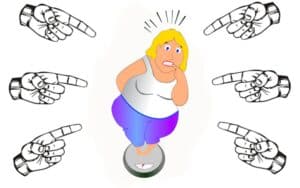
If asked to name the most powerful destructive force on earth, most people would probably answer, “a nuclear bomb,” while a certain proportion would say “shame.” Millions of people feel the pain of shame, mostly generated by factors they can’t control, like having been born with a facial birthmark. This is the secret door to understanding the phenomenon of fat-phobia, the condition that causes a human (who might be a perfect darling in every other way) to fear and/or hate humans who are overweight.
Even someone who might feel compassion for the person with a facial birthmark, or stretch their mind and heart far enough to understand that another person could not help being gay — even someone who is that far advanced will let themselves freely hate a morbidly obese person on the grounds that they didn’t have to be that way.
That person let themselves get fat, made themselves get fat, and does not care one single bit how uncomfortable the sight of their corpulent body makes others feel. Therefore, that person deserves to experience every bit of shame that can possibly be piled on them, from every direction, day and night, for the rest of their disgusting life.
This, Moms and Dads, is one of the very excellent reasons why we would rather not have our kids become overweight.
Your responses and feedback are welcome!
Source: “Stigma: Notes on the Management of Spoiled Identity,” WordPress.com, 1963
Images by Conmongt and Tumisu/Pixabay
 FAQs and Media Requests: