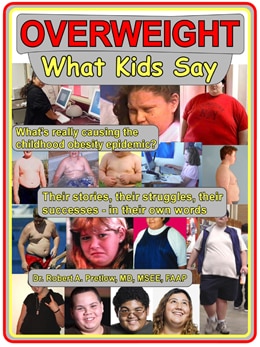
Members of the general public who tend to hunt for scapegoats can’t help noticing a huge category of humans who are eligible to receive a share of the blame for the crushing expense of modern life: the population of obese children, along with their parents, who seem to be co-conspirators in a plot to make everyone else go bankrupt.
Some families receive government assistance with their medical bills, which may be caused or exacerbated by a child’s unfortunate condition. At any given time, there is only so much money to go around, and one school of thought says that available funds should only be spent on kids whose condition was 0% caused by any actions of their own, or by any neglect or wrongdoing on the part of their parents.
And it must follow, as night follows day, that in a universe shaped like that, childhood obesity is always 100% the parents’ fault.
Yes, in certain circles, a child’s obesity is fondly accepted as being his, or her, and/or the parents’ exclusive problem. Each time a medical professional or institution is paid to alleviate a situation caused by obesity, it reduces the funding available to cure children whose medical problems cannot be dismissed as their own fault.
It means that some other child might not obtain help at all. It is the sort of public budget scandal, based on half-baked evidence and janky reasoning, that some taxpayers love to be upset by.
Universal participation
Of course, overweight kids and their progenitors are not the only recipients of blame in modern society. Shamers get blamed too, and blamers also are shamed. There are plenty of bad feelings to go around! Some grownups are blamed for trying to make overweight people feel not just lousy about themselves, but unworthy of human consideration, period. Moreover, obesity arguments tend to metastasize into every aspect of life.
For instance, more than one critic has pointed out that the average passenger airplane seat is an inch and a half narrower than its counterpart of two decades ago. And yet, the average passenger’s rump is not 1.5 lateral inches slimmer than those of his immediate ancestors. Or even close. It gets worse. Some frequent flyers report, instead, that seat width has actually narrowed by an entire two inches, while “leg room” is now as mythical as a leprechaun.
Meanwhile, folks with other interests note that, although airplane seats may have shrunk, theater seats have widened. And yet, that is not universally appreciated. In another context, a different anonymous online malcontent recently complained that theater is a dying art form because the seats are still too small. In their opinion, to discriminate against large-bottomed moviegoers is a losing strategy for an art form that hopes to stay relevant in this day and age.
Freedom of speech
It is not surprising that the more secret a website allows posters to be, the more open their communications become. A pseudonymous woman, for instance, might point out that “Fat people deserve dignity, fat people deserve to be treated with respect, fat people deserve to have their healthcare concerns taken seriously and their healthcare needs met.”
Confronted by unsympathetic normies, some correspondents take great care to explain just why their weight is so difficult to control, while others declare with explosive anger that the reason why a person is fat is nobody’s business and doesn’t matter anyway, when it comes to a basic issue like common courtesy. No one owes a rude stranger, or even a polite one, any justification for their own existence.
Your responses and feedback are welcome!
 FAQs and Media Requests: