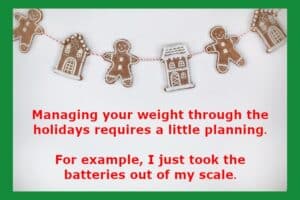
The facetious advice in the picture on this page has been seen millions of times online and is impossible to trace back to its source. But let’s lift a glass of sugar-free fizzy soda and drink to the health of its author. Yes, going forward into the new year, humans will continue to fight against our own best interests. Sooner or later (perhaps in 2026!) more of us will come to see the truth of another anonymous quotation:
You can fool some of the people all of the time, and fool all of the people some of the time, but — ultimately, eventually, inevitably — you can’t fool yourself.
This blog has pointed out many of the societal costs of obesity, so for the end of December, it gathers a little bouquet of talking points from the past year and the past few years, and some things to look out for in the coming months.
There are problems we don’t want to see our kids, or any kids, have to face in the upcoming year or any year subsequent to this one. In other words, let’s poke and prod ourselves to do something about looming obstacles and stop putting off the unpleasant tasks. To stall is to invite consequences that quickly outgrow the unpleasant stage and morph into real-life nightmares.
Interview with an expert
“Watchful Waiting Not Recommended For Childhood Obesity” is the title of a very recent piece by Tim Ditman, and let’s have a peek at what the expert he interviews has to say about the subject.
The American Academy of Pediatrics (AAP) has been taking a second look at some of its guidelines and softening its attitude toward surgery and medication. Some parents became nervous about venturing beyond the traditional guardrails of diet and exercise, and this is understandable.
Too often in life, the urge to “Do something!” becomes diverted or misapplied. The only thing worse than neglecting a problem is approaching it with the wrong tool. Maybe the error even lies in the mental construct of attack. Maybe “address” or “examine” is a better approach. So we do not want to start out with a misstep. When aiming for a compass bearing, even a single degree of error can lead to far, far from the intended destination.
One thing is for sure:
The AAP says waiting and hoping things get better is not a good choice.
Up until about age 12, sure, stick with the traditional methods, but beyond that age, “diet plus exercise” is not a sufficient prescription. The AAP is talking about, among other remedies, “in-person, family-based behavioral health treatment” for three months to a year. After passing that 12-year mark, the organization says, let’s start thinking about a pharmaceutical approach; and after the 13th birthday, in many cases surgery should not be arbitrarily ruled out.
Registered dietitian-nutritionist Carly Zimmer feels empathy for the difficulties that children face. Their lives are saturated with “activity” that involves mainly sitting on their ever-enlarging behinds, watching screens that glorify and strenuously recommend eating all the wrong stuff, and plenty of it. Yet and still, very often the food is not the enemy — the mind is.
Zimmer says,
Often our eating habits stem from events in our past, trauma or emotions. A mental health professional can dive into those topics and help establish a healthy relationship with food.
This is what needs to happen, not an eternal relationship with weight-loss meds acting as a band-aid, because a band-aid is glued to a person only to be replaced. That is why they are sold by the package. Commitment to a lifetime of regular injections of a very expensive drug is not a solution; not a win or a cure, or any other positive description of an outcome. It is a very poor alternative to what is ultimately possible, and many professionals are deeply committed to never settling for less.
Zimmer offers suggestions which, yes, have been heard before. That isn’t the point. If a concept has value, it is worth hearing a thousand times — until someone whose health hangs in the balance actually absorbs it. For parents, Zimmer suggests a technique that begins by adding, not subtracting. Go ahead and give the kid the same old cereal for breakfast, but offer fresh fruit, too. Maybe at some point, this particular individual will become more interested in the fruit and abandon the cereal.
Be the grownups
Get used to the idea that sometimes a child will be hungrier than other times, and don’t make a big thing out of it if they occasionally consume what you think is too much or too little. And forget that tired old “Join the clean plate club!” nonsense. Please do not set a heap of food in front of a kid. Let them start with a small serving of the fattening stuff, and maybe they will surprise you by scarfing down all the green beans.
Don’t let yourself be discouraged. You can place the same food in front of a child 20 times, only to see it scorned; and then, one day, they will eat it. When the child eventually caves and admits the stuff isn’t so bad after all, refrain from sarcasm. And now, Zimmer gives advice worth gold: “Don’t make exercise a chore.”
Parents, if there is some physical, active, calorie-burning activity your child enjoys, embrace it. Please. Find where the kid can go skateboarding or swimming, or learn gymnastics or Jiu-Jitsu, or whatever sort of exercise they can get behind. Please give them a chance to try an activity before committing to it. Make the time, find the money (it will probably not cost as much, ultimately, as weight-loss drugs or surgery), and figure out how to retain this as a major part of life, for as long as the child is into it. The rewards will be vast.
Your responses and feedback are welcome!
Source: “Watchful Waiting Not Recommended For Childhood Obesity,” RiverBender.com, 10/13/25
Image by JillWellington/Pixabay
 FAQs and Media Requests: